
God’s Mechanics: How Scientists and Engineers Make Sense of Religion by Brother Guy Consolmagno, S.J.

[Read 11/2007] Religion. 2007

In God’s Mechanics Brother Consolmagno discusses religion from a “techie” standpoint. Br. Consolmagno is an astronomer, and many of his friends/coworkers are either scientists or in other technical fields. He tells both his and their stories about how to reconcile a life of faith with a life in science. I enjoyed this book tremendously; Br. Consolmagno shows how he (and others) can have “unprovable” religious beliefs and still work every day in highly scientific or technical fields.

He poses three questions that postulating the existence of God is useful in answering:

  1. Why is there something instead of nothing?
  2. What is the source and object of my deepest yearnings?
  3. How do I make sense of my life?

Some notes on what Br. Consolmagno says in this very engaging book:

The urge to find something “out there”, or the longing to find meaning is the search for the transcendent. It is very unsatisfying to just have a God who is responsible for the creation of the universe (question 1) but then has no further interest in it. What then, would be the point of our lives?

Religion: The various “sacred” scriptures serve as a sort of database – a record of the community’s history of interaction with the transcendent. It’s a template against which we can compare our own experiences of the transcendent. The collective religious wisdom (and Tradition) gives us the tools to “throw out” data points too far from the norm.

Sacraments are a concrete “thing” that only a Church can provide. The function of religion is to get closer to God, and the function of God is to address the fundamental questions of meaning and purpose. However, you cannot insist (or assume) that religious doctrines are a complete and final description of nature and God. Our understanding of God is always incomplete – as St. Paul says, “through a glass, darkly”.

Catholic theology notes that all doctrine, no matter how authoritative, embodying divine truth, still requires interpretation because our understanding of that truth is expressed in a given time and in an historically conditioned language and culture.

He recommends Saint Augustine (~400 AD): “On the literal meaning of Genesis” (trans. by John Hammond Taylor, S.J. 1982). Augustine puts a creative spin on biblical passages, as when he says “Let there be light” actually refers to instilling rationality into intellectual creatures.

A particular strength of Catholicism over denominations where worship depends totally on music and preaching is that even the most tasteless liturgy with the most inane homily from a priest who’s an outright scoundrel doesn’t stop a Mass from being a valid and worthwhile source of grace.

The absence of an electron looks mathematically like the presence of a hole [ in a semi-conductor ], just as the absence of good can look like the presence of an entity called evil.
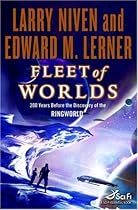
Fleet of Worlds by Larry Niven and Edward Lerner

[Read 11/2007] Science Fiction. 2007

Fleet of Worlds is set in the Ringworld universe and is about the Puppeteer’s “Fleet of Worlds” – the Puppeteer’s en mass migration of their whole planet (and supporting food-producing worlds) away from the exploding galactic core.

The story takes place 200 years before the Ringworld discovery. Nessus the Puppeteer is one of the main characters (we see him in later Ringworld books). The other main characters are human “colonists” that the puppeteers supposedly “saved” 500 years earlier and are now living on one of the puppeteer planets. They serve the puppeteers, but have their own society on the continent “Arcadia”.

Three colonists, Kirsten, Eric, and Omar are trained by Nessus to be advanced scouts for the puppeteers. The truth about the colonists’ past is starting to come out, and comes to a head when Kirsten and the others find “The Long Pass” – the humans’ “lost” ship from 500 years ago.

Good, “modern” SF read, very much unlike Lerner’s Moonstruck.

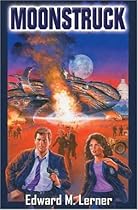
Moonstruck by Edward Lerner

[Read 10/2007] Science Fiction. 2005

Moonstruck reads like a sort of “retro” 1950’s SF novel. It’s a fun, but superficial read. Aliens land in D.C. and offer humans membership in the “Galactic Commonwealth”. Most people on the planet believe the aliens, except for Kyle Gustafson (the President’s science advisor) and Darlene Lyons (a junior diplomat at the UN).

When nations’ satellites start blowing up or malfunctioning, a new cold war erupts as most of the world doesn’t believe the U.S. is working with all of humanity. Another alien, using her native form, crash-lands on earth and tells a very different story. Who is telling the truth? The first aliens also have a surprise up their sleeve – and it’s on the moon.

I’d have to file this under bathroom reading. :)

The Accidental Time Machine by Joe Haldeman

[Read 10/2007] Science Fiction. 2007

The Accidental Time Machine by Joe Haldeman is a fun, quick read. Ok, “mind candy”. This is on par with Camouflage for character development, i.e., not much. Mathew, an ABD MIT grad student builds a detector in his prof’s lab. He finds out by chance that hitting the “reset” button causes the machine to jump forward in time. However, each time it is used, it goes forward about 12x further (few seconds, an hour, few hours, a day, etc.). Mathew can’t duplicate the machine. His girlfriend recently dumped him, and he loses his lab position to rival. After a ~15 year jump he finds his professor used his notes and had taken credit for the discovery (and won a Nobel). But the professor still can’t duplicate the machine. More jumps into the future, and he meets Martha. He is “expected” at MIT, but it now is the Institute of Theosophy (and no tech). Mat and Martha jump forward, meet an AI, some future “humans”, etc.

Recommended for an Airplane Read.

Halting State by Charles Stross

[Read 10/2007] Science Fiction. 2007

Halting State by Charles Stross is a great read. This book reminds me of Spook Country by William Gibson however the tech in Stross’ book is more believable and this is much more of an SF/Police procedural. The book is in the uncommon? “second person”, i.e., “you” perspective. Three viewpoints are shown: Scottish detective Sue Smith, forensic accountant Elaine, and programmer Jack.

Basically the book opens with a bank robbery. However the “bank” is within a virtual world of an online RPG. This heist will wreak havoc with the in-game economy and will result in millions of *real* dollars being lost if the heist becomes known to gamers. Elaine is called in by the game company to help find the bad guys – because in addition to being an accountant she is also a gamer. However, Elain is into LARP (live action role playing) where she dresses up and uses heavy period (and real) swords. Jack is hired to act as her online gaming “guide”. Jack not only plays RPG’s but writes the software for a major online RPG company.

As Elaine and Jack team up to solve the case, there is a lot of tech and plot spun up with them. The book is set in 2018 and the tech extrapolation is believable. Stross’s use of current jargon also helps immerse the reader in the story.

HIGHLY recommended.