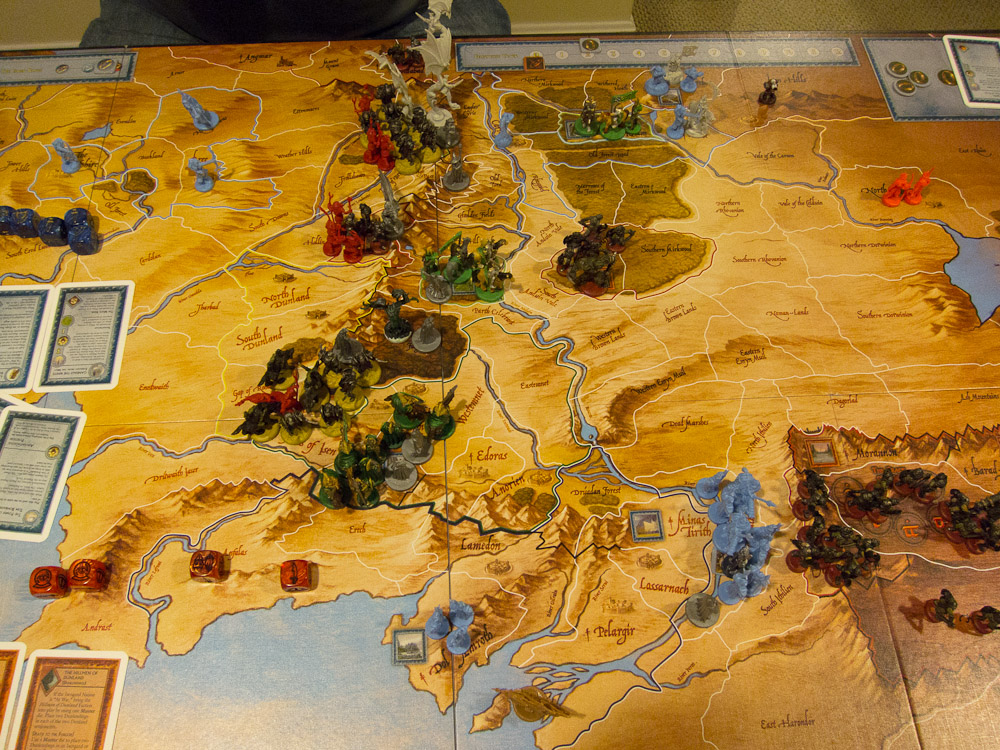
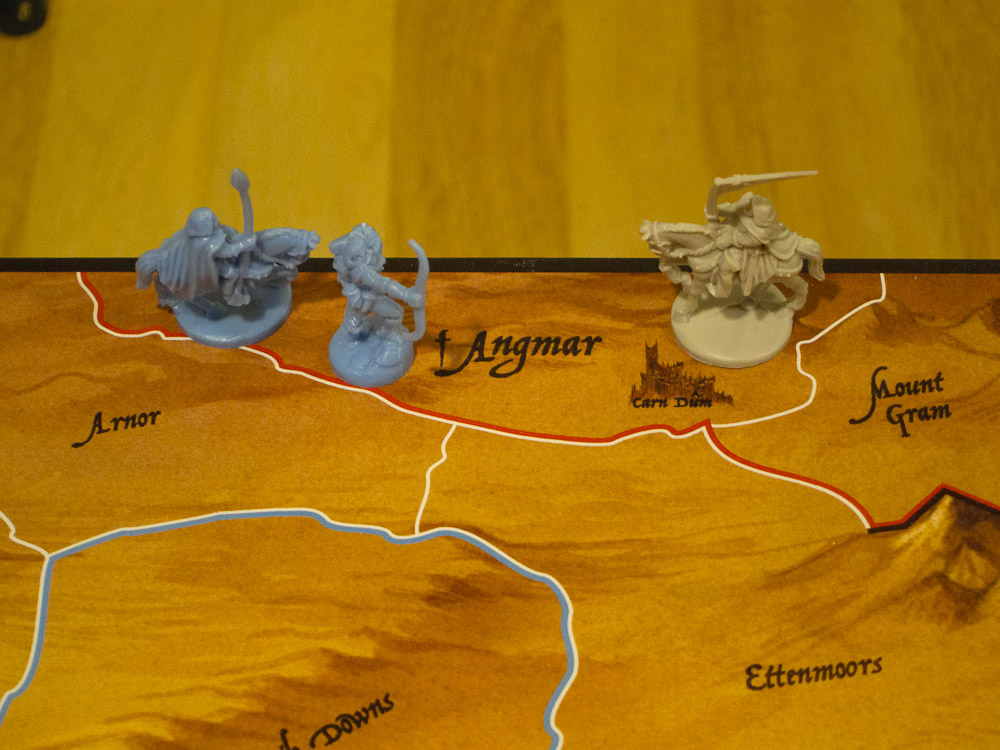
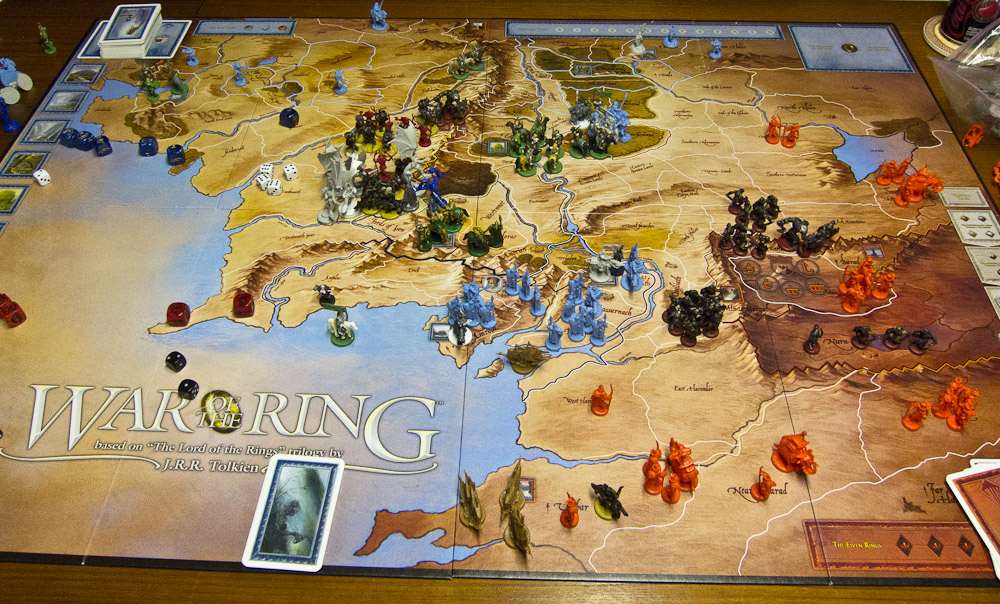
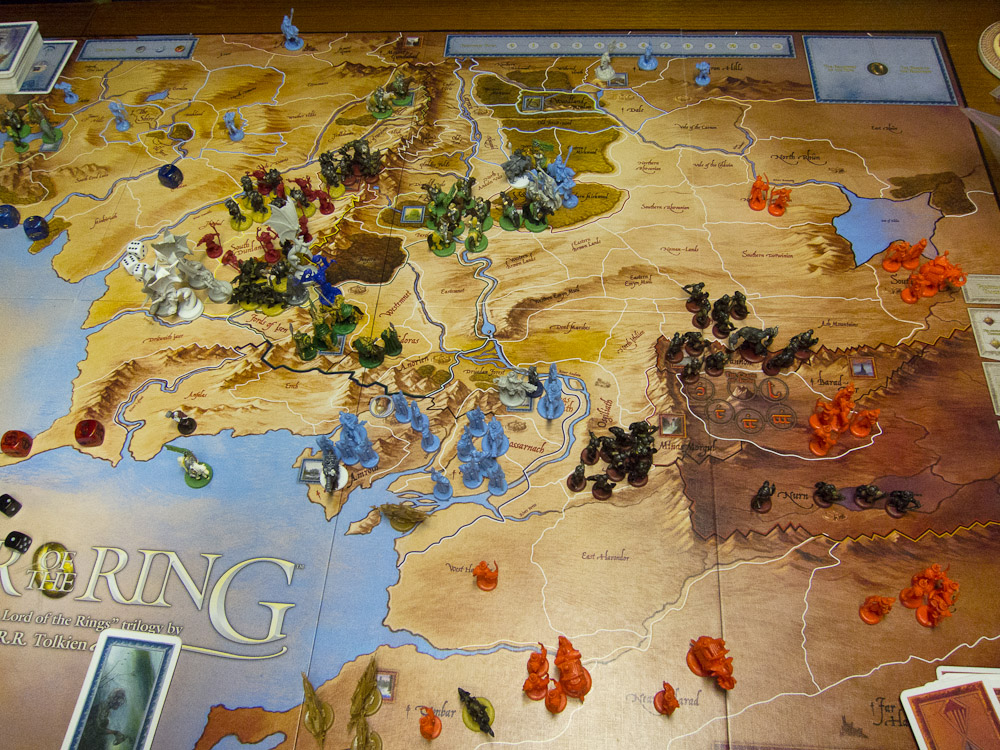
Right. Played War of the Ring again last night (my second time). Still learning the game, but more importantly, still really enjoying the game! Played the Sauron side again, and lost again. From what I hear it’s unusual for the Free People’s side to win a Military victory, but not when playing against me, apparently. I wasn’t paying enough attention (again) to the Victory points the Free Peoples (led by George again) were amassing. Angmar is worth one, and is on the other side of the board from me. George even pointed out that I should probably watch out it doesn’t get taken. What I did was misjudge how long it would take me to re-take other areas (ok, and the dice didn’t play nice). But so much fun. This time game only lasted 3.5 hours.
Mike (playing Twilight Imperium at the next table) made some comment over his shoulder about how I should read up on some strategy. Ya think?
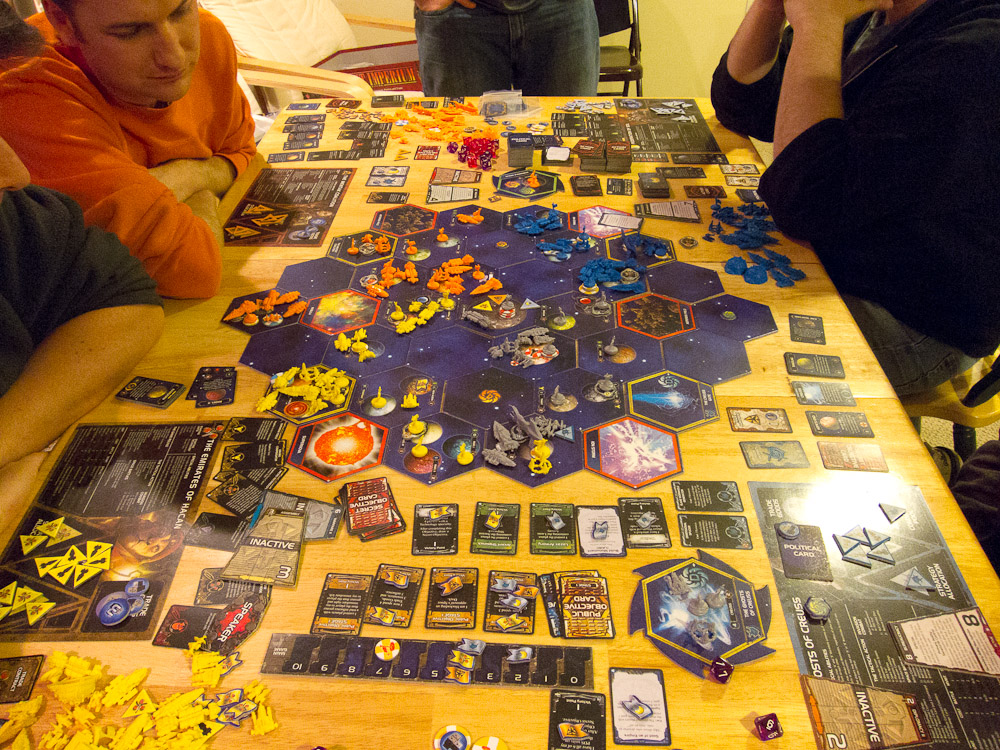
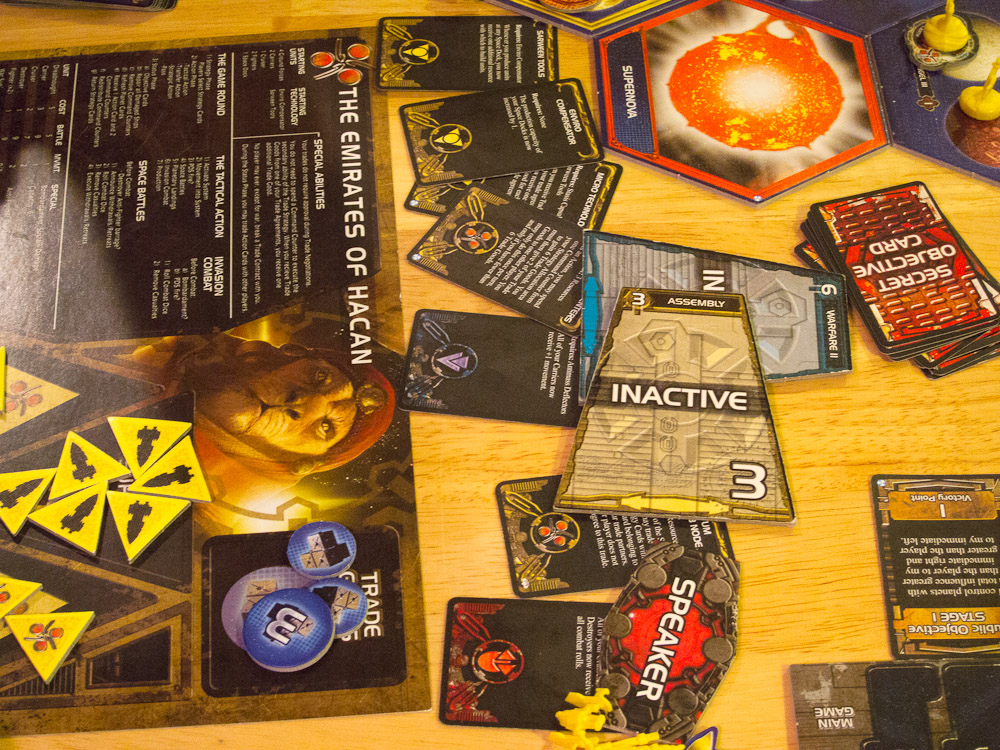
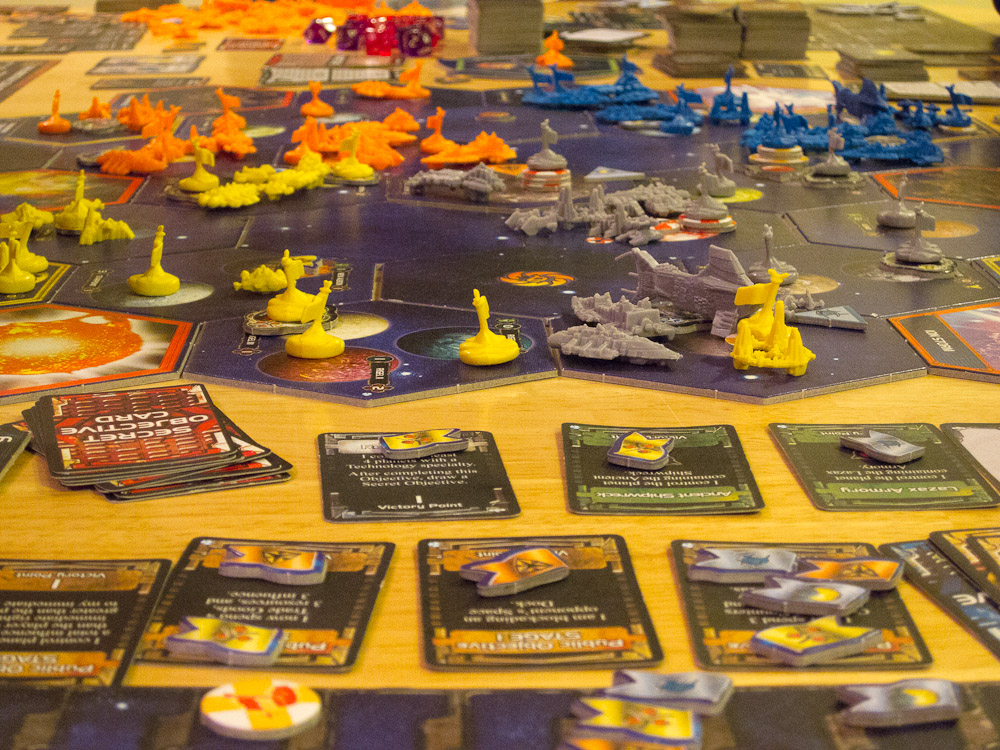
Some of the other guys were playing Twilight Imperium. That’s a bigger setup and even more complex. I look forward to learning that one in the future… especially if I get to play the lion-faced race; they just look cool.
War of the Ring
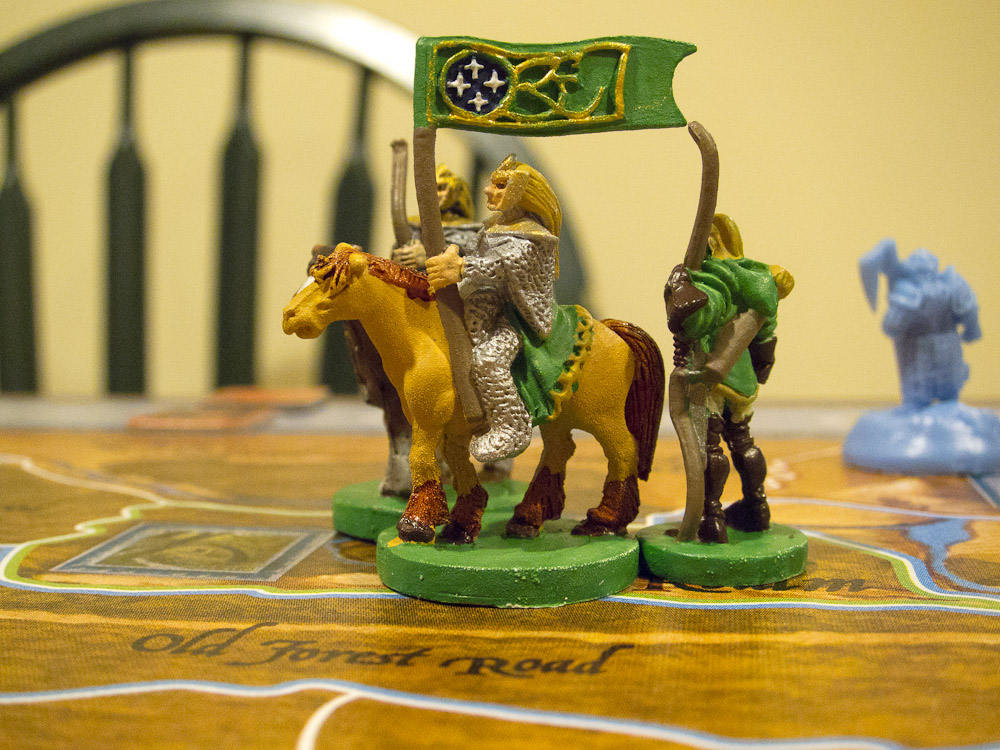
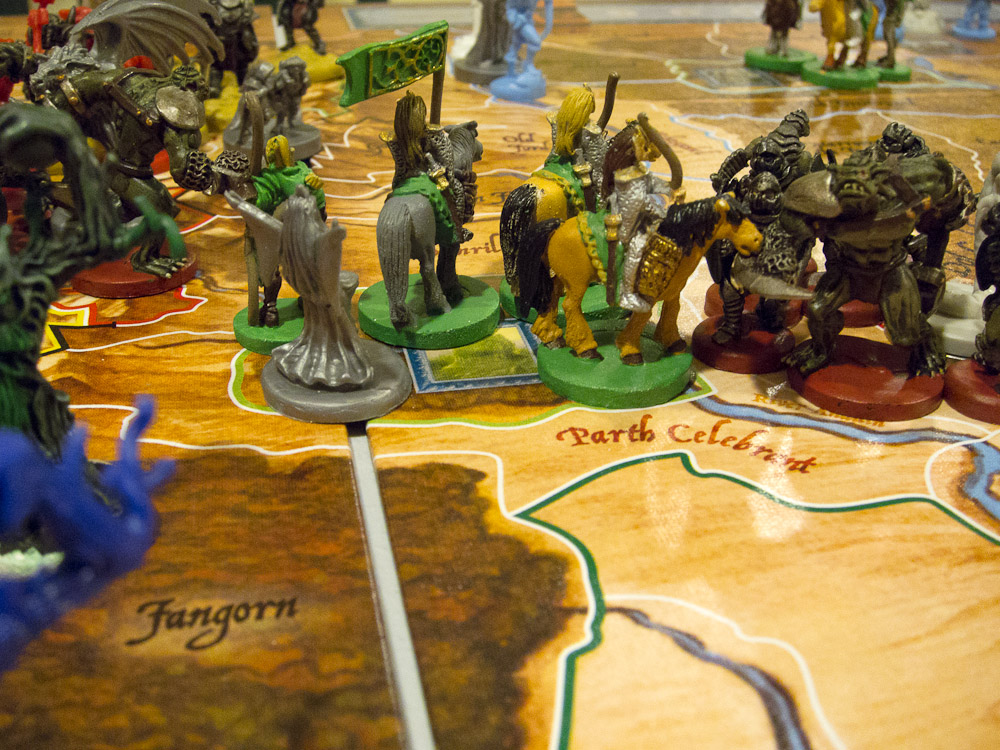
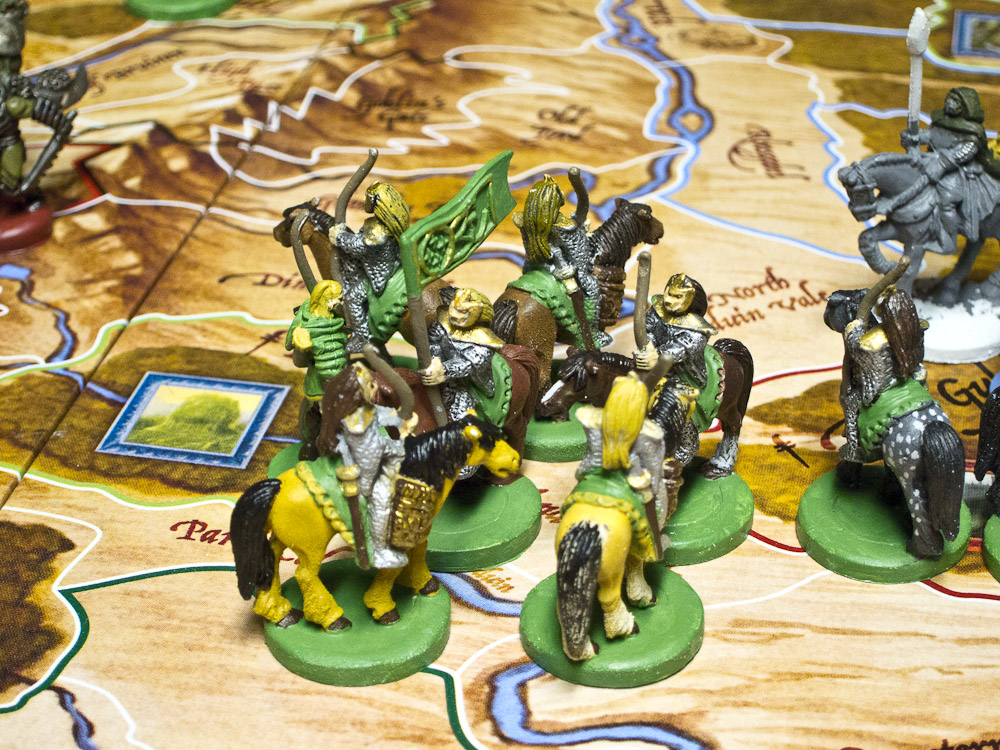
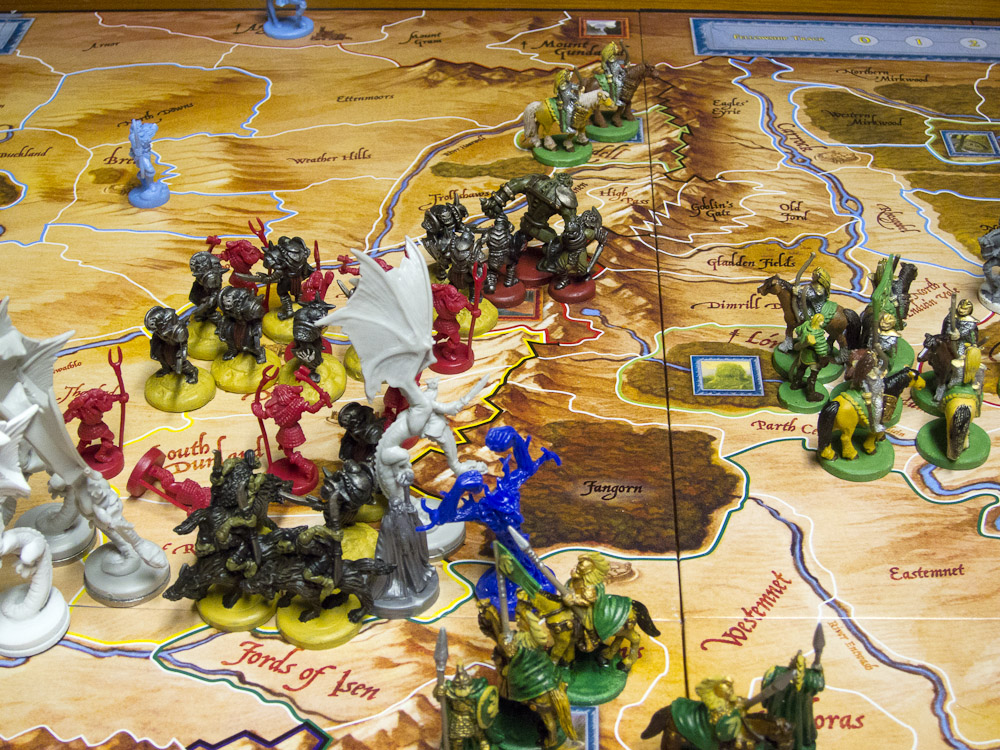
War of the Ring – closeup of painted miniatures
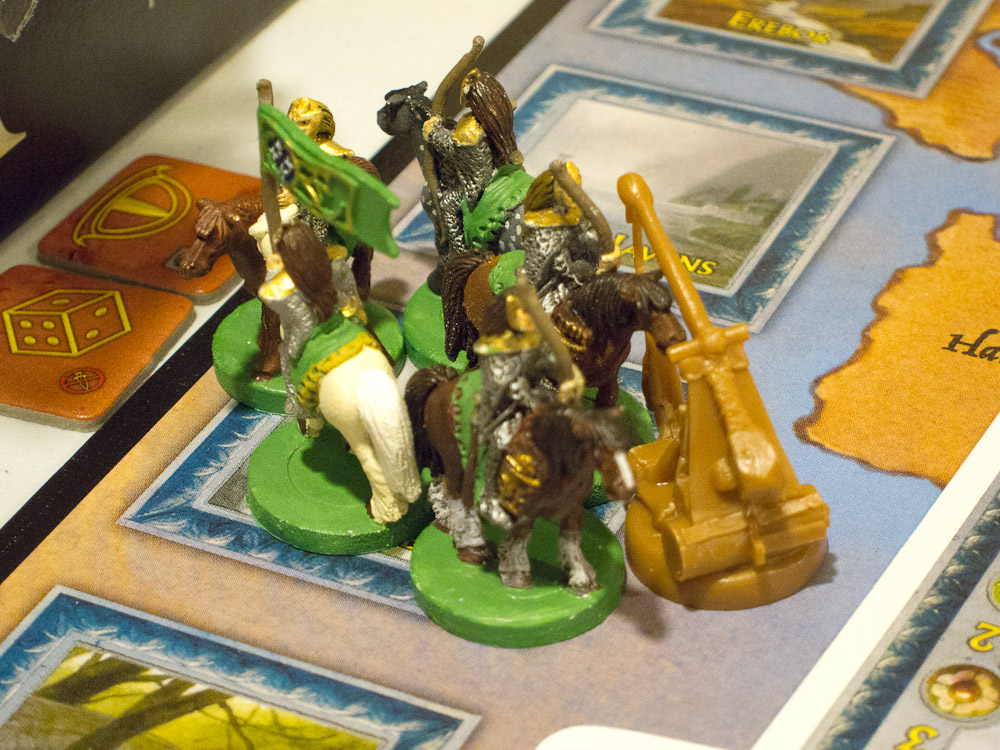
War of the Ring – closeup of painted miniatures
War of the Ring – closeup of painted miniatures – under siege!
War of the Ring – closeup of painted miniatures – darn Angmar cost me the game
Last night I was introduced to War of the Ring by George from my Board Game group. I arrived at 8pm. By 12:30am George had won (2-player game), but I was enjoying the game so much that it felt like only an hour or so had passed.
It is a two-player game, though you can play 3-4 players (as teams). One side plays the Free Peoples of Middle Earth (Gondor, Rohan, Elves, Dwarves, etc.) and the other side plays the Shadows (Sauron, Isengard, Southrons, etc.). Last night I played the Shadow side. What makes the gameplay so enticing are the basic game mechanics: special action dice (with symbols) determine which actions a player can take. Play alternates between players (after rolling all dice (up to 10, I think, for Shadow and 6 for Free Peeps), each player plays one action die at a time so there is very little downtime in the game. Coupled with action, character, etc. cards the number of options can be a bit overwhelming. But George was a good teacher. :)
There are two ways to win: Military victory or Ring victory. For a military victory the Shadow side has to control enough of the board to get 10 Military points while the Free Peeps only need 4. Capturing areas is similar to other area-capture games (like Risk): roll die and inflict casualties or receive them. Again, lots of options (via character card, etc.) for increasing odds for offense or defense.
For a Ring victory, the Free Peeps have to get the Ring to Mordor (and drop it into the lava) or the Shadow side has to inflict (12?) corruption points onto the Fellowship.
Sounds complicated, and it is (due to options available for each action), but basic gameplay is easy to understand. I can imagine it will take a few more times playing before I become familiar with all (or most) of the various options/scenarios. I do look forward to playing again! Maybe I can get a copy (it’s out of print so can be pricey) and get Dylan to play – he likes Risk and reading fantasy, so…
There are something like 200 (plastic) miniatures for the game as well as 100 cards, and over 100 cardboard markers and tiles! George had started painting the miniatures for the game; he did a great job – they look so much nicer than the plain single-color original plastic pieces. Nice!
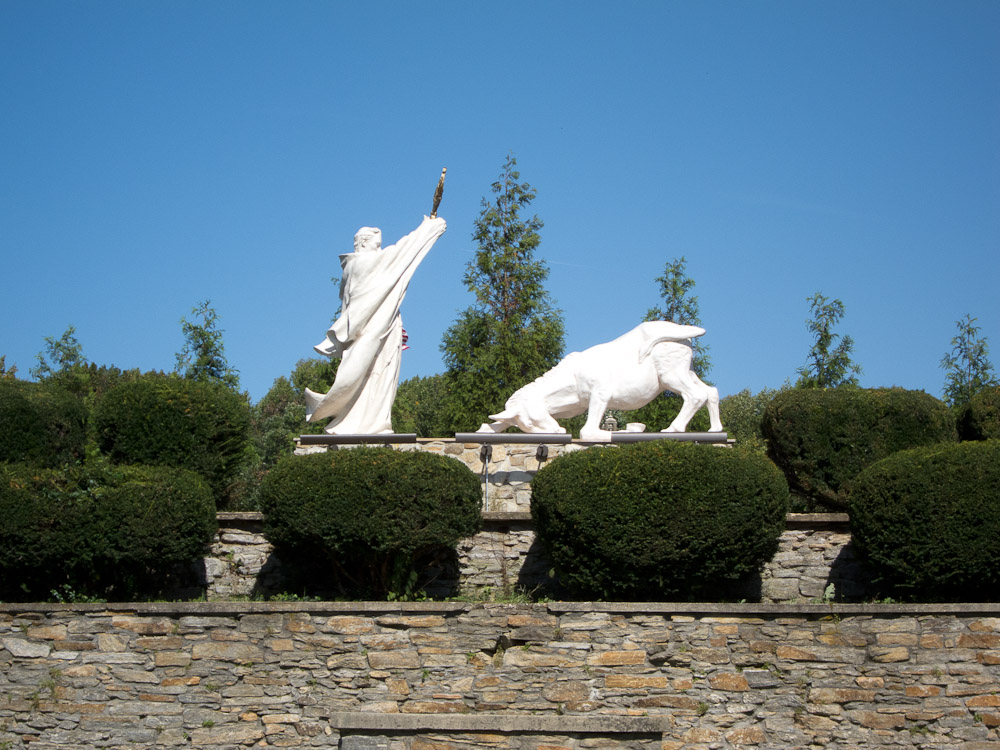
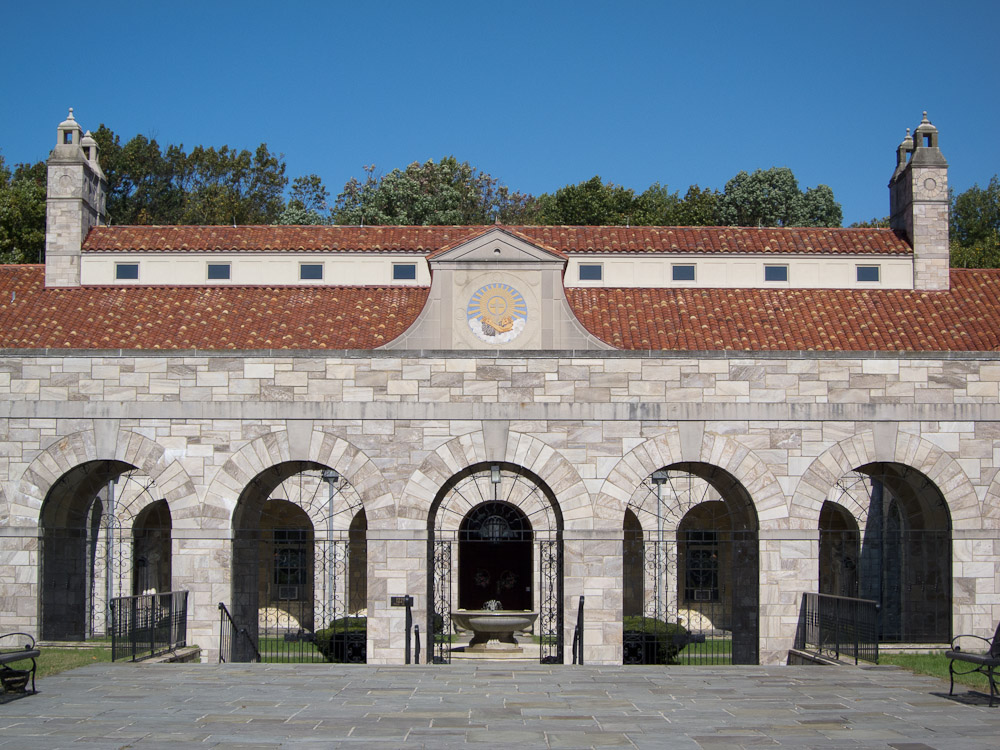
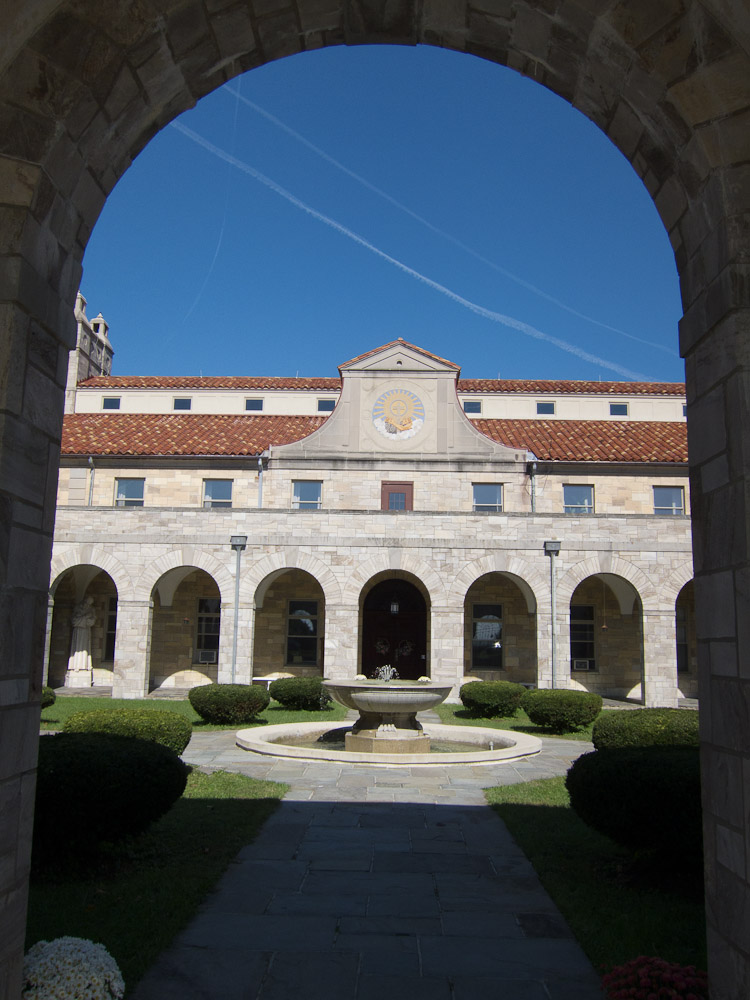
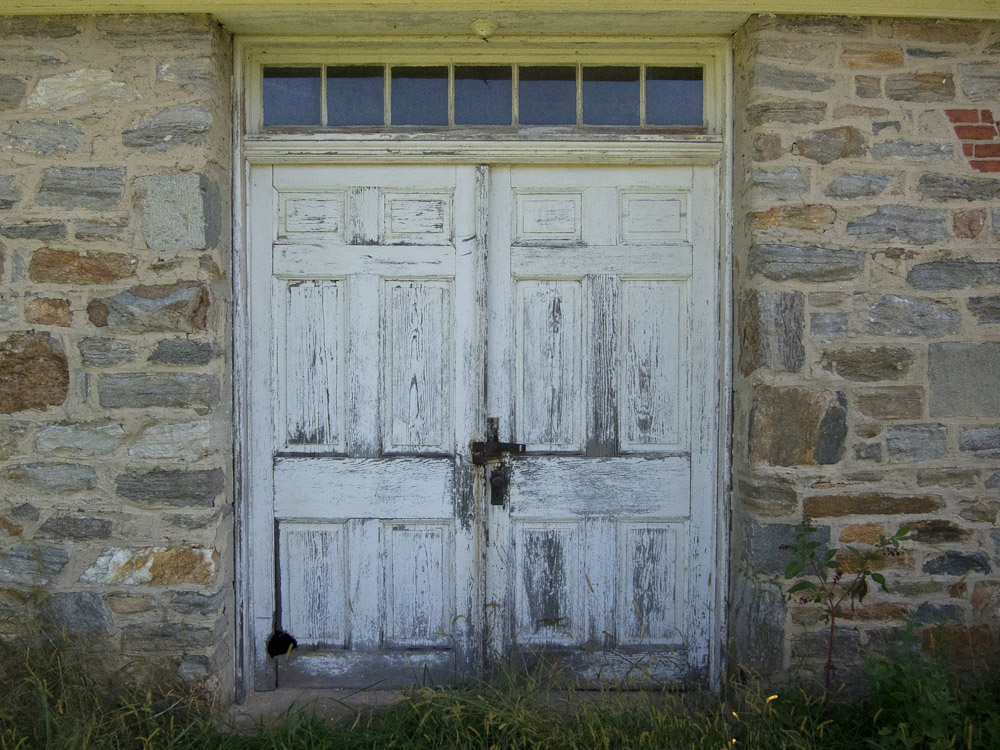
The weather was so nice today that after Mass at the Shrine of St. Anthony (the Friary) I took a few moments to snap some pictures of the Shrine and grounds. I’m at the Shrine often, but for some reason I rarely take pictures. As I had my point-and-shoot (Canon s95) with me, I thought this was too photogenic to pass up…
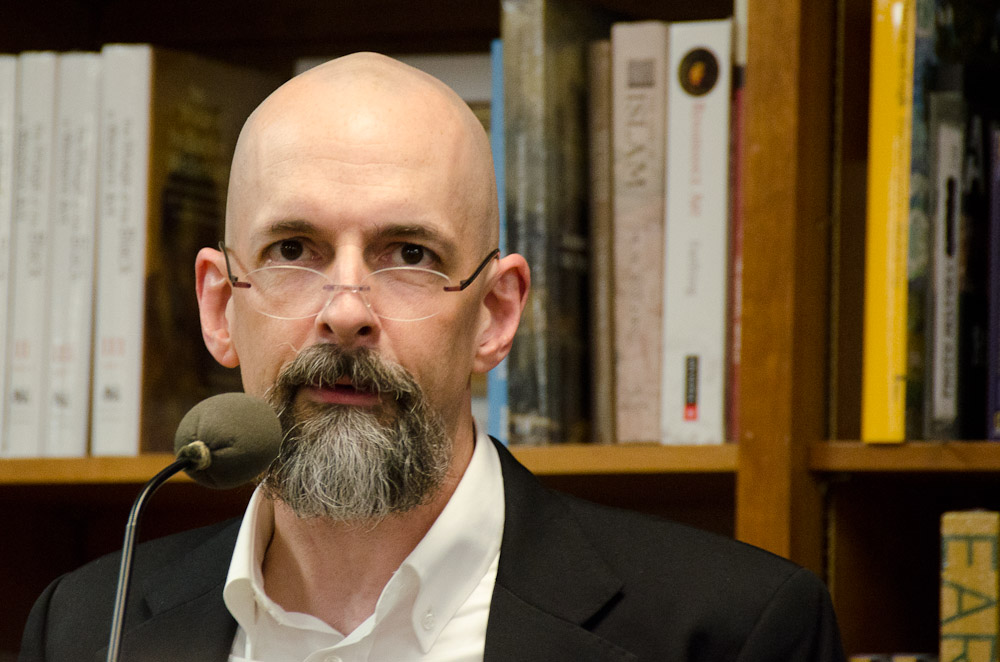
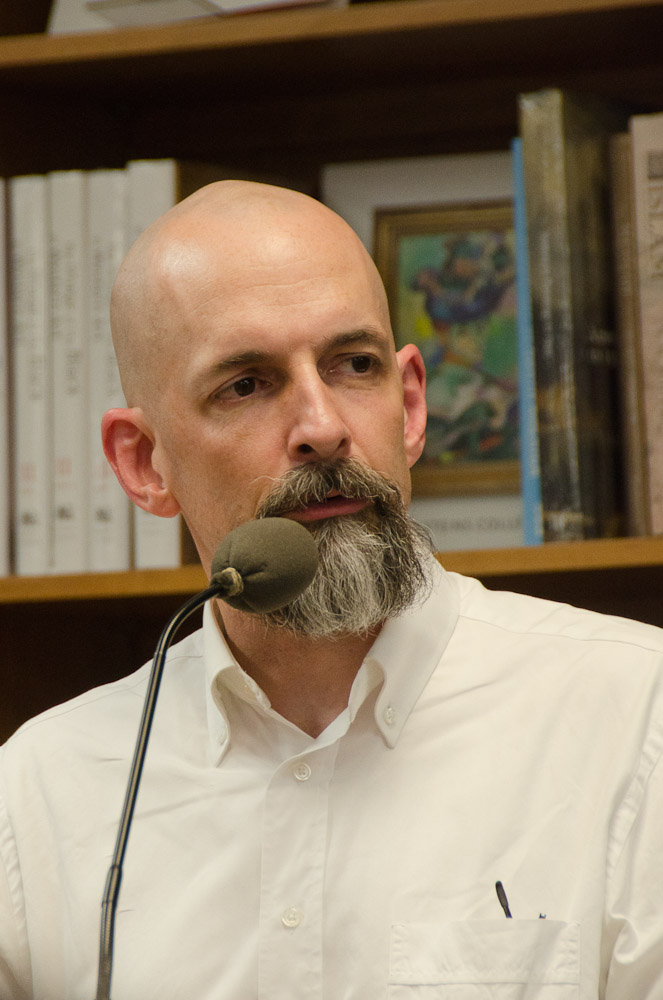
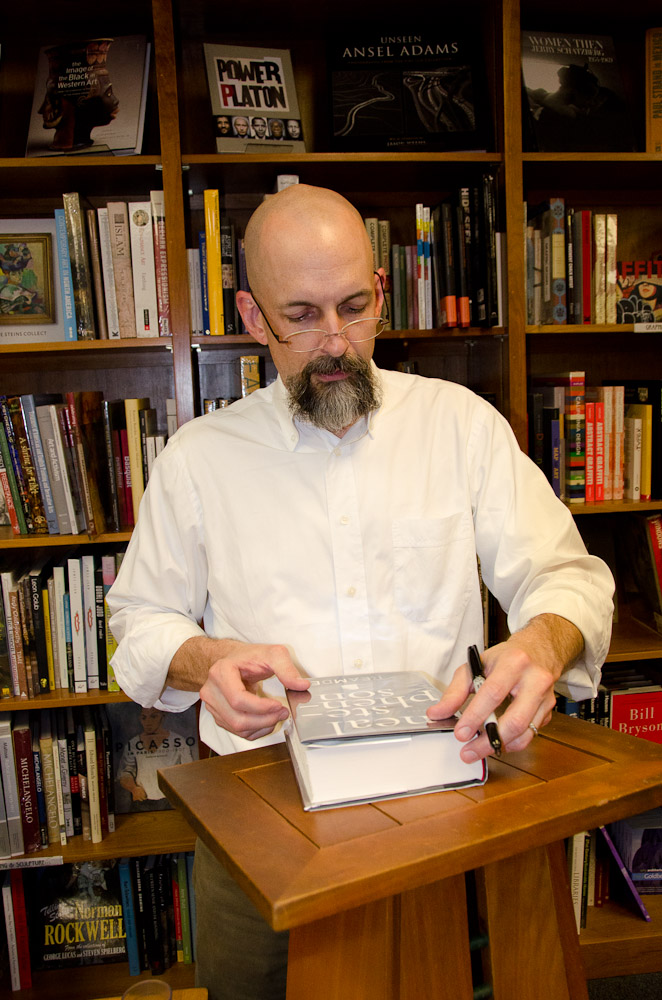
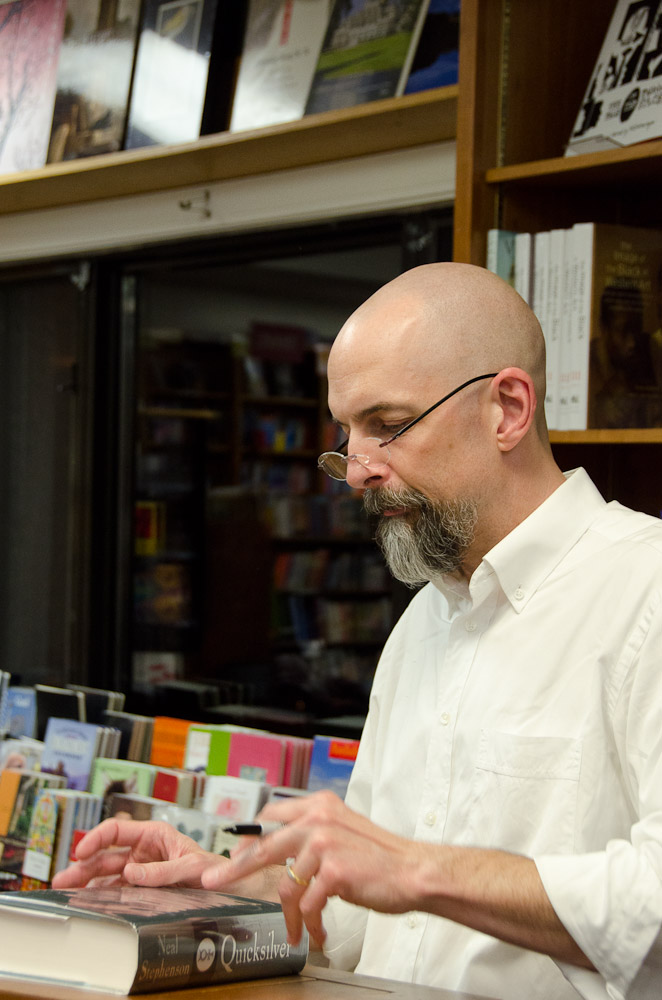
Neal Stephenson was at Politics and Prose Bookstore in Washington DC on Saturday night. He gave a reading from his new book, Reamde. Fun reading, and very interesting Q&A session afterwards. He then gladly signed books…
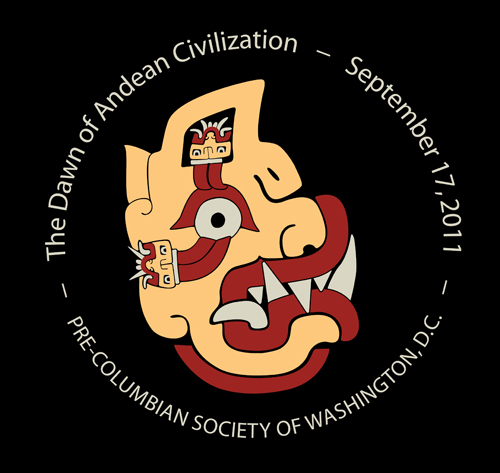
Last Saturday I attended a very interesting all-day seminar in Washington, DC. The Pre-Columbian Society of Washington DC has an annual symposium at the U.S. Navy Memorial’s Naval Heritage Center. At right is the design on the symposium T-shirt. It is a feline character (I’m going to assume a jaguar) from an adobe mural at Huaca Partida, Nepeña Valley, Peru (something like > 1500 years ago). Neat.
This location is very convenient; right at the Archives Metro stop on the Green line. This year’s topic was “The Dawn of the Andean Civilization. The link above goes to the symposium website; here is a synopsis:
ChavÃn de Huántar, the massive ceremonial center constructed more than 3,000 years ago high in the Peruvian Andes, attests to the great antiquity of Andean civilization, but the roots of this florescence occurred at least two and possibly three millennia earlier. During this one-day symposium some of the world’s most renowned Andean scholars will present new research that challenges current notions about the genesis of Andean society. Did a singular, linear progression emanating from one early center lead to the magnificence of ChavÃn de Huántar and, later, the splendor of the Moche kings and the majesty of Tiwanaku? Or did the many pinnacles of achievement that make up the rich tapestry of ancient Andean culture emanate from multiple centers? Did different traditions emerge along the coast and in the highlands? In the north and in the south? Did these developments occur everywhere at the same time? This symposium will examine these and other questions, revealing a dynamic period that witnessed the first large-scale monumental architecture, large permanent settlements, intensive food production, social stratification, and widespread distribution of shared art forms and religious practices. So please join us for a day of new insights into the dawn of Andean civilization.
I really enjoyed the seminar; I have visited Peru (on my honeymoon) but that was basically to see Machu Picchu (Incan, ca. 1500 AD). This seminar focused on the northern coast of Peru (north of Machu Picchu), from about 1200 BC to 600 AD – much earlier. Prior to this series of talks, I had almost no knowledge of the Pre- Moche civilizations of the Andes so this was a very enlightening day.
Plenty of breaks, and for lunch I visited Teaism (right across the street) for a delicious “chicken curry” dish and an IPA. Then back for more talks. I’ll post a synopsis of the talks from my notes at a later time…
PROGRAM
8:15 a.m. — REGISTRATION, Morning Refreshments
9:00 a.m. — WELCOME AND OPENING ANNOUNCEMENTS
9:15 a.m. — Playing in the Dark: Archaeological Analysis and Evidence at the Dawn of Andean Civilization *Tom Dillehay
10:15 a.m. — BREAK
10:45 a.m. — Household Archaeology and the Emergence of Social Complexity at Peru’s North Central Coast: New Perspectives from the Late Preceramic Site of Bandurria, Huacho Alejandro Chu
11:35 a.m. — The Role of the Casma Valley in the Development of Early Andean Civilization Tom and Shelia Pozorski
12:25 p.m. — LUNCH
1:45 p.m. — The Settling of the Landscape: What This Meant to Formative People in the Titicaca Basin, Bolivia Christine Hastorf
2:35 p.m. — Changing Views on the Andean Formative Period: The Perspective from ChavÃn de Huántar John Rick
3:25 p.m. — BREAK
3:50 p.m. — The Dawn of Andean Civilization as Viewed from the Shores of Peru’s Central Coast Richard Burger and Lucy Salazar
4:40 p.m. — BOOK DRAWING BREAK
4:50 p.m. — Panel Discussion All Speakers (Moderated by Dr. Dillehay)
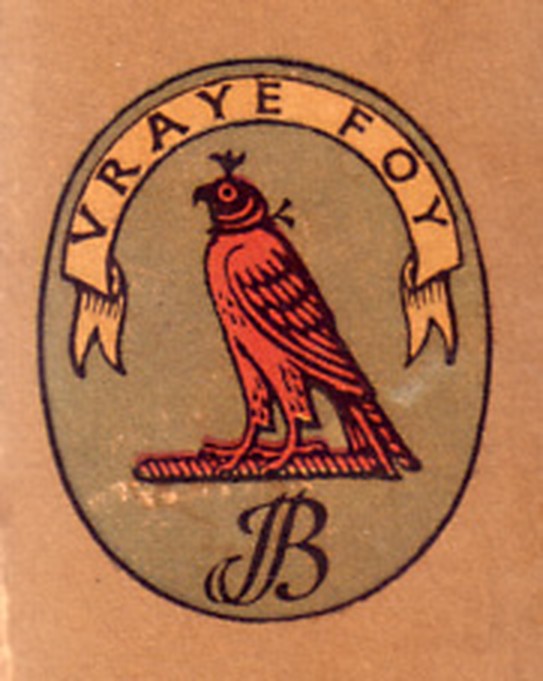
Vraye Foy — “true faith”, the Boswell motto, on a bookplate of the family crest: a hooded hawk. Click anywhere to close.