
Posts by boz

Last Days of the Incas

MacQuarrie The boys and I went to see Kim MacQuarrie give a talk Thursday night about his new book, “The Last Days of the Incas” at Olsson’s Bookstore in Arlington, VA. MacQuarrie is a documentary filmmaker, and he spent some 4+ years in Peru. While there he spent some time living among a “newly discovered” Amazonian Indian tribe. His interest in the Inca was piqued, and he subsequently spent 3 years researching and writing this book. He goes over the story of how ~160 Spanish were able to “conquer” some 30,000 Incas (and eventually the entire Inca civilization of some 10 million). The Spanish killed the Inca ruler Atahualpa in a despicable double-cross (the Inca had filled a room with gold as a ransom; the Spanish took the gold and killed Atahualpa anyway). That story is well known. Turns out the Inca didn’t just lay down their arms quietly after that. The book goes on to tell about the ~40 year “guerrilla” war the Inca waged against the Spanish after the execution of the Inca ruler. He touched on the “discovery” in 1911 of Machu Picchu by Hiram Bingham, and also for the modern search for the lost Inca city of Vilcabamba ( the search is still underway).

Enjoyable talk, and the author inscribed a copy of the book to me afterwards. I believe he currently lives in the DC area. Interestingly, I saw him on the subway on the way home later in the evening (he was in another car); I wonder if he saw me reading his book. :)

The audio recording of the talk is available (from my Canon Powershot S3 IS).

Tastes like chicken

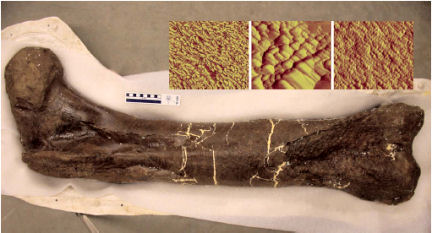
t.rext. rex leg bone

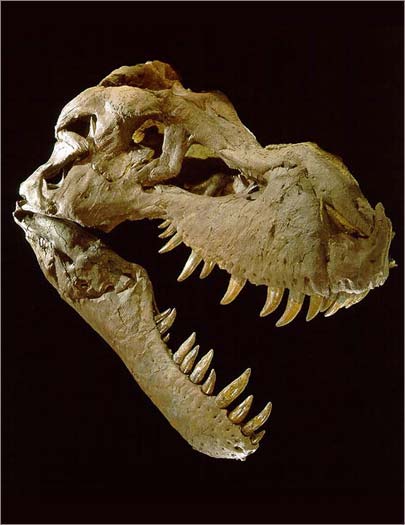
A recent paper in Science [Science 13 April 2007: Vol. 316. no. 5822, pp. 277 – 280] reports that fossil proteins have been found in a leg bone of a Tyrannosaurus rex. In fact, intact collagen proteins have been found in this 68 million-year old specimen. Most fossils of this age contain no soft tissue, since soft tissue would have long ago been replaced by minerals during the fossilization process. Further testing of the fossil protein reveals it is very similar to that found modern-day chickens. This is further evidence favoring the theory that birds are actually living descendants of dinosaurs. Interesting!

A readable account is at The Economist website.

Walter Isaacson, Arthur Phillips recent events

img_0772.jpg

On Saturday I attended a discussion by Walter Isaacson for his new biography, “Einstein: His Life and Universe”. Very interesting discussion; I’m quite eager to read the biography. I recorded the lecture for those interested in hearing it. I did read the author’s previous biography on Benjamin Franklin, and enjoyed it.

In addition, last night I went to a signing by Arthur Phillips, for his new book: “Angelica“.


This is the second time I’ve attended a reading by this author (a couple of years ago I went to his “The Egyptologist” reading).

I really enjoyed Arthur Phillip’s reading/talk (which I also recorded). I didn’t expect the boys to be interested (I took them to Comet Ping Pong prior as a sort of “pre-reward”), but both asked pointed questions about ghost stories and why the author liked/disliked them.
Angelica is written in 4 parts, with 4 different points of view. One of the parts involves ghosts and/or the supernatural. The book has received good reviews, but I need to find time to read The Egyptologist first. My stack of “to be read” books seems to increase by 2-3 each time I read one. Oh well – one can never have too many books; and I’ll never run out of new material to transport me out of a mundane world. :)

Non-green plants on other planets

nongreen plants
NASA scientists can now predict the color of plants on other planets, and they may well not be green. On Earth photosynthetic plants are primarily green, due to the color of chlorophyll. Chlorophyll in plants is responsible for photosynthesis, which converts the (light) energy of the sun into (chemical) energy of sugars such as glucose. Chlorophyll appears green because it absorbs more red and blue light and less green light (i.e., it reflects more green). Since more red light actually reaches the surface of the earth than green, Nature has optimized chlorophyll to use the most abundant (red) light. However, other planets, circling other stars, may have a different wavelength of light predominant on the surface. Thus, the “chlorophyll” on other planets may have evolved to absorb this light and reflect something other than green.